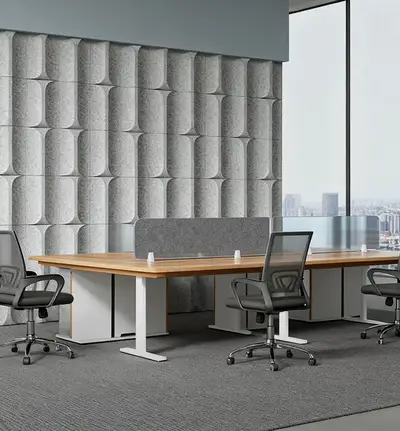

High-performance acoustic panels are essential for managing sound reflections, reducing unwanted reverberation, and improving the acoustic comfort of indoor environments. They are commonly used in recording studios, offices, conference rooms, educational facilities, restaurants, and commercial buildings. Although these products may look straightforward, their effectiveness depends on careful material selection, precise manufacturing techniques, and thorough quality testing.
A professional Acoustic Panel Factory follows a series of controlled production stages to transform raw materials into finished acoustic solutions. Every step, from preparing the absorbing core to applying decorative finishes, can influence the panel’s performance, durability, and appearance. Understanding this process helps buyers evaluate product quality and select panels that meet their specific project requirements.
1. Selecting the Right Raw Materials
The manufacturing process begins with choosing materials that provide suitable sound absorption and structural properties. Different acoustic panel designs require different materials depending on their intended applications, thickness, density, and finish.
Common materials include:
- Polyester fiber: A lightweight material used in various sound-absorbing panels. It is available in different densities, thicknesses, and colors.
- Mineral wool: Frequently used in acoustic products because of its sound absorption and thermal insulation properties.
- Fiberglass: A material used in many commercial and architectural acoustic applications.
- Wood-based materials: Commonly incorporated into perforated or slatted acoustic panels that combine sound management with decorative appeal.
- Acoustic fabrics: Used as surface coverings that allow sound to pass through to the absorbing material underneath.
Material selection should reflect the intended environment. For example, panels installed in a commercial office may have different appearance and durability requirements from products designed for a recording studio.
2. Inspecting and Preparing Materials
After sourcing, raw materials undergo inspection before entering the production process. This helps identify inconsistencies that could affect the finished product.
Manufacturers may check material thickness, density, dimensions, surface condition, and general suitability. Fabric coverings may also be inspected for color consistency, texture, and visible defects.
Preparation methods depend on the material. Fiber-based components may require cutting or compression, while wood-based materials may need drying, machining, or surface preparation.
Proper material preparation supports consistent production and reduces the likelihood of defects during later stages.
3. Processing the Acoustic Core
The acoustic core is one of the most important parts of an absorbing panel. Its material composition, thickness, density, and internal structure influence how sound interacts with the product.
Depending on the design, manufacturers may use cutting, molding, bonding, layering, or compression to prepare the core. These processes help achieve the required dimensions and physical characteristics.
Core preparation must follow defined product specifications. Inconsistent thickness or material density can result in variations between panels, making production control particularly important for large commercial orders.
4. Precision Cutting and Shaping
Once the core and other components are ready, they are cut into the required shapes and dimensions. Standard rectangular panels are widely used, but customized products may include geometric patterns, curved designs, or specialized dimensions.
Modern factories may use precision cutting equipment, CNC machinery, and digital design systems to improve accuracy. These technologies help manufacturers produce repeatable shapes and maintain consistent measurements.
Accurate cutting is important for several reasons:
- It allows panels to fit their intended installation areas.
- It supports uniform spacing and alignment.
- It reduces unnecessary material waste.
- It improves the appearance of completed installations.
- It helps maintain consistency across multiple production batches.
For projects involving large wall or ceiling areas, even small dimensional differences can become noticeable after installation.
5. Creating Perforated and Slatted Panel Designs
Some acoustic panels use perforated or slatted surfaces to combine sound absorption with decorative finishes. These designs are commonly used in offices, conference rooms, hospitality interiors, and public buildings.
Manufacturing may involve drilling, routing, CNC machining, or other precision processes to create openings in wood or composite surfaces. An absorbing material is often positioned behind the decorative layer to improve sound absorption.
The size, spacing, and arrangement of openings influence the product’s acoustic behavior and visual appearance. These features should therefore be designed according to the intended product specifications rather than selected for decoration alone.
6. Assembling the Panel Structure
After individual components have been prepared, they are assembled into the finished panel structure. Depending on the design, this stage may involve attaching an acoustic core to a backing, adding a frame, securing multiple layers, or preparing mounting components.
Fabric-wrapped panels require careful positioning and tensioning to create a smooth, even surface. Wooden acoustic panels may need accurate joining and secure attachment of the decorative face to the absorbing backing.
Manufacturers must ensure that the assembled components remain stable and that the construction meets the required dimensions. Proper assembly also helps prevent loose edges, gaps, and other defects that could affect product appearance or installation.
7. Applying Decorative Finishes
The visible finish is an important consideration for modern acoustic products. Commercial customers often want panels that complement their interior design while providing suitable sound absorption.
Common finishing options include:
- Fabric coverings in different colors and textures.
- Natural wood veneers.
- Decorative laminates.
- Painted or coated surfaces.
- Customized geometric patterns.
- Coordinated finishes for walls and ceilings.
Finishing methods must be compatible with the acoustic design. For example, an inappropriate surface coating or covering could restrict sound from reaching the absorbing core.
Careful finishing helps ensure that panels meet both visual and functional expectations.
8. Inspecting Dimensions and Construction Quality
Quality control takes place throughout manufacturing, but dimensional and structural inspections are especially important after assembly.
Manufacturers may check panel length, width, thickness, edge alignment, bonding strength, surface condition, and mounting components. These checks help confirm that the finished products match approved specifications.
For customized projects, inspection may also include comparing finished panels with approved samples or design drawings. This is useful when multiple products need to match in color, size, and construction.
Identifying problems before packaging reduces the likelihood of installation difficulties and customer complaints.
9. Testing Acoustic Performance
High-performance acoustic panels should be evaluated using appropriate acoustic testing methods. Appearance and material descriptions alone cannot establish how effectively a product absorbs sound.
Laboratory testing may measure sound absorption coefficients across different frequencies. The Noise Reduction Coefficient (NRC) is another commonly used measurement that summarizes absorption performance over specified frequency ranges.
When reviewing acoustic test reports, buyers should pay attention to:
- The testing standard used.
- The laboratory and test conditions.
- Panel thickness and material construction.
- Mounting arrangement during testing.
- Absorption results at individual frequencies.
- Whether the tested sample matches the product being purchased.
It is important to understand that acoustic panels primarily absorb sound energy within a space. They are not automatically soundproofing products. Reducing sound transmission between rooms generally requires additional measures involving walls, doors, ceilings, and structural construction.
10. Checking Safety and Environmental Requirements
Commercial projects may have specific requirements concerning fire performance, material emissions, and environmental characteristics. These requirements depend on the building type, local regulations, and intended application.
Manufacturers should provide relevant documentation where available. Buyers may need to review fire-test classifications, emissions information, material safety details, and other applicable certifications.
It is important to verify that documents relate to the exact product and construction being considered. A certification for one material or panel design should not automatically be assumed to apply to every product in a manufacturer’s range.
11. Final Inspection and Packaging
Before delivery, finished panels undergo final checks to confirm that they meet the approved specifications. Inspectors may review dimensions, surface appearance, structural condition, labeling, and product quantities.
Packaging is equally important because acoustic panels can be damaged during handling and transportation. Manufacturers may use protective wrapping, corner guards, cartons, and pallet arrangements according to the size and fragility of the products.
For large projects, clear labeling helps contractors identify different panel types, dimensions, colors, and installation locations. Proper packaging and documentation support smoother handling after delivery.
12. How Modern Technology Improves Manufacturing Efficiency
Technology continues to improve acoustic panel production by increasing precision and supporting better production planning.
Computer-aided design systems help manufacturers prepare detailed product drawings, while CNC machines allow accurate cutting and shaping. Automated processing equipment can also improve repeatability when producing large quantities.
Digital production records and inspection systems make it easier to monitor manufacturing stages and identify recurring defects. These improvements can help reduce material waste, improve production efficiency, and maintain consistent product specifications.
However, reliable manufacturing still depends on skilled operators, suitable materials, and effective quality management. Technology is most valuable when integrated into a well-organized production process.
13. What Buyers Should Evaluate Before Purchasing Acoustic Panels
Understanding the manufacturing process gives buyers a useful foundation for comparing products and suppliers. Before placing an order, consider the following factors:
| Evaluation Factor | What to Review |
|---|---|
| Raw materials | Material type, thickness, density, and suitability |
| Manufacturing precision | Cutting accuracy and dimensional consistency |
| Construction | Bonding, assembly, and structural stability |
| Surface finish | Color, texture, and visible quality |
| Acoustic performance | Relevant laboratory test reports and specifications |
| Safety documentation | Applicable fire and emissions information |
| Customization | Available sizes, shapes, and finishes |
| Quality control | Inspection procedures throughout production |
| Packaging | Protection during handling and transportation |
Requesting product samples and technical documents can make comparisons more reliable. For larger projects, confirming specifications and approving samples before mass production can help prevent costly mistakes.
Conclusion
The manufacturing process behind high-performance acoustic panels involves much more than assembling sound-absorbing materials. It requires careful material selection, controlled processing, precision cutting, reliable construction, suitable surface finishing, and appropriate acoustic testing. Final inspections and protective packaging help ensure that products arrive ready for installation.
For architects, contractors, and business owners, understanding these stages makes it easier to evaluate acoustic panel quality and compare manufacturers. By considering material specifications, verified acoustic performance, construction standards, and customization capabilities, buyers can select products that support better indoor sound conditions while meeting the visual and practical needs of their projects.