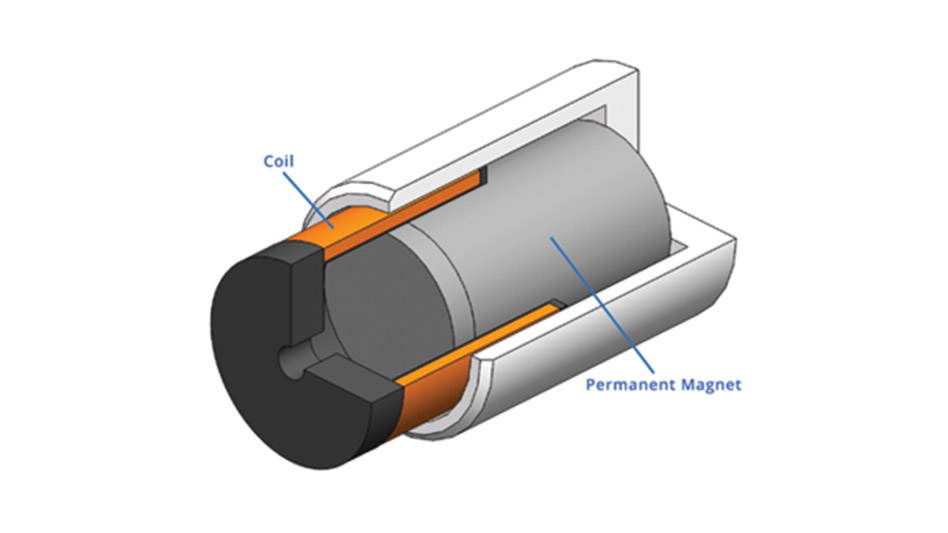

Voice coil motors are precision electromechanical devices widely used in applications that require fast, smooth, and highly accurate linear or rotary micro-motion. They operate based on electromagnetic principles that convert electrical energy directly into controlled mechanical movement, making them essential in modern automation, robotics, and high-precision industrial systems.
In advanced motion control technology, a voice coil motor is valued for its direct-drive operation, which eliminates mechanical transmission components such as gears, belts, or lead screws. This results in frictionless movement, high responsiveness, and excellent positioning accuracy, especially in systems that demand micro- or nano-scale adjustments.
Working Principle of a Voice Coil Motor
The working principle of a voice coil motor is based on the Lorentz force law. When an electric current flows through a coil placed within a permanent magnetic field, a force is generated perpendicular to both the magnetic field and the direction of current.
This electromagnetic interaction produces controlled motion without physical contact between primary moving parts. The direction and magnitude of movement depend directly on the current input, allowing precise control of force and displacement.
Key characteristics of this principle include:
- Force is directly proportional to input current
- Motion direction changes with current polarity
- Instant response with minimal mechanical delay
- Smooth force generation without cogging effects
Electromagnetic Motion Control Mechanism
Electromagnetic motion control in a voice coil motor is achieved through precise regulation of current within the coil. By adjusting current levels in real time, the system can control position, velocity, or force with high accuracy.
This control process typically involves:
- A permanent magnet generating a stable magnetic field
- A coil that produces force when energized
- A feedback system measuring position or force
- A controller adjusting current based on real-time data
The integration of feedback ensures that the motor responds accurately to changing conditions, maintaining stability and precision.
Role of Magnetic Field Design
The performance of a voice coil motor depends heavily on the quality of its magnetic circuit. A well-designed magnetic field ensures consistent force output across the entire motion range.
Important design factors include:
- Uniform magnetic flux distribution
- High-strength rare-earth magnets such as neodymium
- Optimized air gap for stable force generation
- Low magnetic leakage for efficiency improvement
A stable magnetic field is essential for achieving predictable and repeatable motion behavior.
Advantages of Voice Coil Motor Technology
Voice coil motors offer several advantages over traditional mechanical motion systems:
- High-speed response and acceleration
- Smooth motion without mechanical backlash
- Precise force and position control
- Low friction and reduced wear
- Compact and lightweight structure
These features make them highly suitable for applications requiring fine motion control and rapid adjustments.
Applications in Precision Industries
Voice coil motors are widely used in industries that demand high accuracy and fast response times. Common applications include:
- Optical focusing and imaging systems
- Semiconductor wafer positioning and inspection
- Medical diagnostic and surgical equipment
- Precision testing and calibration devices
- Robotics and micro-positioning systems
In these environments, even small motion errors can significantly affect performance, making electromagnetic precision control essential.
Conclusion
Voice coil motors provide a powerful solution for precise electromagnetic motion control. Their working principle based on Lorentz force, combined with advanced feedback systems, enables smooth, accurate, and responsive movement. As industries continue to demand higher levels of precision and speed, voice coil motor technology will remain a critical component in next-generation motion control systems.