
In industrial processing, grinding technology plays a crucial role in determining product quality, efficiency, and consistency. Industries such as paints, coatings, chemicals, ceramics, and pharmaceuticals rely on different types of milling systems to achieve desired particle size reduction.
Among the most commonly used methods are bead milling and ball milling. While both are designed for grinding materials into finer particles, they differ significantly in design, working principle, and application efficiency. In many modern production systems, a bead mill is preferred due to its precision and ability to achieve ultra-fine dispersion. A widely used solution in this category is a bead mill, which is designed for high-efficiency wet grinding and uniform particle distribution.
Overview of Bead Mill and Ball Mill
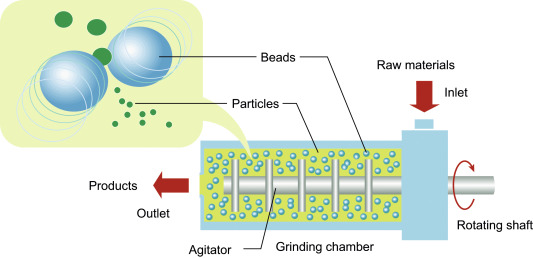
A bead mill is a wet grinding machine that uses small grinding media (beads) to break down particles in a liquid medium. It is widely used for fine dispersion and nano-level particle size reduction.
A ball mill, on the other hand, uses larger steel or ceramic balls in a rotating cylinder to grind materials. It is typically used for coarse or medium grinding applications.
Both systems serve important roles, but their performance and precision levels vary significantly.
Working Principle Comparison
Bead Mill Working Principle
A bead mill operates using high-speed rotation of a rotor that agitates small grinding beads inside a chamber. The beads create intense impact and shear forces, which break down particles efficiently.
This process is continuous, controlled, and highly efficient, making it suitable for fine and ultra-fine grinding applications.
Ball Mill Working Principle
A ball mill works on a simple principle: as the cylinder rotates, the grinding balls tumble and crush the material inside. The process relies mainly on gravity and impact forces.
While effective for bulk grinding, it offers less control over particle size distribution compared to bead milling.
Key Differences Between Bead Mill and Ball Mill
1. Grinding Media Size
- Bead mill uses small beads for fine grinding
- Ball mill uses large balls for coarse grinding
2. Particle Size Output
- Bead mill achieves ultra-fine and nano-level particles
- Ball mill produces relatively coarser particles
3. Efficiency and Speed
- Bead mill offers high-speed, continuous processing
- Ball mill operates at slower speeds with batch processing
4. Energy Consumption
- Bead mill is more energy-efficient for fine grinding
- Ball mill consumes more energy for similar output
5. Application Areas
- Bead mill is used in paints, inks, chemicals, and pharmaceuticals
- Ball mill is commonly used in mining, ceramics, and cement industries
Why Bead Mill Is Preferred in Modern Industries
In today’s manufacturing environment, precision and efficiency are more important than ever. A bead mill provides better control over particle size distribution, making it ideal for high-quality applications.
Its advantages include:
- Superior dispersion quality
- Faster processing times
- Consistent particle size output
- Suitable for sensitive materials
- Continuous operation capability
These benefits make bead milling a preferred choice in industries requiring fine and uniform grinding.
Limitations of Ball Mills
While ball mills are still widely used, they have certain limitations:
- Lower precision in particle size control
- Longer processing times
- Less efficient for ultra-fine grinding
- Higher energy consumption in some cases
Because of these limitations, ball mills are often replaced by more advanced technologies in precision-based industries.
Industrial Applications of Bead Milling Technology
Bead mills are widely used across multiple industries due to their versatility and efficiency:
Paints and Coatings
Ensures smooth pigment dispersion and improved color quality.
Pharmaceuticals
Helps achieve fine suspensions for better drug performance.
Chemicals
Used for emulsions and specialty chemical formulations.
Inks and Printing
Provides stable and uniform ink dispersion for high-quality printing.
Cosmetics
Produces smooth textures in creams and lotions.
Conclusion
Both bead mills and ball mills play important roles in industrial grinding, but their applications differ significantly. While ball mills are suitable for coarse grinding, bead mills offer superior precision, efficiency, and control.
In modern manufacturing environments, the use of a bead mill has become increasingly common due to its ability to deliver fine particle size reduction and consistent dispersion quality. As industries continue to demand higher performance materials, bead milling technology will remain a key solution for advanced grinding applications.